Exploring Ways to Engage Beyond Academia
This resource gives you an overview of different ways you can engage with communities, industry, policymakers, and the third sector. There isn’t a single “right” route, and it’s important to consider what aligns with your interests, aims, and values as you explore these powerful mechanisms to transform your research and ideas into action.
External engagement opens possibilities: you can pursue work that you feel is meaningful and useful for society, the economy, and the environment. At the same time, you’ll broaden your experiences, build networks, and, develop practical skills that enhance your employability within and beyond academia.
You may be approaching external engagement for the first time, or you may already have experience working with organisations beyond academia. The sections below introduce a range of engagement routes to help you identify approaches that align with your interests, experience, and aspirations. We are continuing to develop this resource and will add new content, examples, and guidance over time.
1. Collaborative Research
(joint projects, studentships, sponsored research & Knowledge Transfer Partnerships)
What it is:
‘Collaborative research happens when two or more partners want to work together on a joint programme of research. Universities collaborate with many different types of organisations, including industry, charities, and government organisations’ (Intellectual Property Office, 2022).
Academics and external partners co-design and undertake research. This can range from publicly co-funded collaborations to industry-sponsored projects and studentships, including formal schemes like Knowledge Transfer Partnerships (KTPs).
Publicly co-funded collaborations (e.g. via UKRI calls) with a non-academic partner making a cash or in-kind contribution; intellectual property/publication terms are usually pre-agreed at application stage.
Industry-sponsored projects / studentships (e.g., Industrial Doctoral Landscape Awards – formerly known as iCASE) — joint academic and industry supervision, placement; terms set by UKRI plus a top-up from the partner.
Knowledge Transfer Partnerships (KTPs) — a graduate/associate sits in the company for 12–36 months delivering an innovation with academic supervision; grants part‑funded by Innovate UK.
Sometimes doctoral research is undertaken within the context of a broader collaborative project or is specifically funded as a partnership with an external organisation. Researchers at all levels of seniority may work collaboratively with partners as part of their core methodology, to secure relevant data or seek external insight into their research problem, and to optimise outcomes and impact.
The case studies below illustrate how researchers have developed mutually beneficial collaborations with industry and charitable organisations to address shared challenges and generate meaningful impact in different contexts.

Research-industry collaboration for sustainable farming and healthy fish
Discover how Jack Jarvis worked with farmers and the British Trout Association to optimise water chemistry and support more sustainable trout farming practices.
Read more about Jack's case study
Research-charity collaboration puts pregnancy research into practice
Learn how Victoria Salmon partnered with a third-sector organisation to address challenges in routine antenatal care and improve outcomes for service users.
Read more about Victoria's case study2. Contract Research
What it is: Research commissioned and funded by an external client under a contract (distinct from a research grant applied for competitively). Terms often specify deliverables, timelines, intellectual property, and publication review.
How it is set up and managed (typical):
Often managed via your university’s Research & Contracts/Pre-Award teams; expect a budget, milestones, data/ethics plan, and a contract from the client.
Intellectual property (IP)/publication: Clients may seek ownership or a licence to foreground IP and ask for publication review/embargo to protect commercial interests and/or confidentiality; negotiations to ensure academic dissemination rights where possible.
Governance & security: Apply institutional research integrity and trusted research & innovation checks (partners, data flows, export controls).
Contract research can be a starting point that leads to longer term collaborations. The case study below demonstrates how contract research can act as a stepping stone to longer-term partnerships, evolving from an initial conversation into a formal project and ultimately a major collaboration with industry.

the driving forces behind partnerships for new cancer treatments
Find out how Professor Mark Cragg turned an initial discussion at a conference into a contract research project with an industry organisation.
Read more about Mark's case study3. Consultancy
What it is: Short, fee-for-service projects where you (or a small team) provide expert advice, analysis, training or review to an external organisation. Typically, no new research is generated; you’re applying existing expertise.
How it is set up and managed (typical):
Route consultancy through your university’s consultancy unit: they scope, price, contract, insure, and invoice so you can focus on the work.
Intellectual property (IP) & outputs: Consultancy is usually not intended to create new IP. Deliverables may include advice, services, reports or other agreed outputs. Where testing or data analysis is involved, ownership and usage rights for materials, data and resulting outputs, as well as publicity rights, should be agreed and explicitly stated in the contract.
Tax/time/costing: The individuals and teams responsible for managing it will quote day rates (or fixed fees), manage conflicts, and ensure appropriate insurance and export/trusted research checks.

Applying forensic solutions to industry problems
Learn more about Laura’s work in a specialist team partnering with industry to solve real-world problems through targeted, application-driven research.
Read more about Laura's case study4. Commercialisation of Research
(intellectual property (IP), patents, licences, spinouts & entrepreneurship)
What it is: Turning research outputs into products/services, for example by protecting/managing IP and licensing or assigning it to an existing organisation, or by forming a spin‑out to develop it further. It can also include commercialising know‑how and expertise, depending on what the “research output” is.
How it is set up and managed (typical):
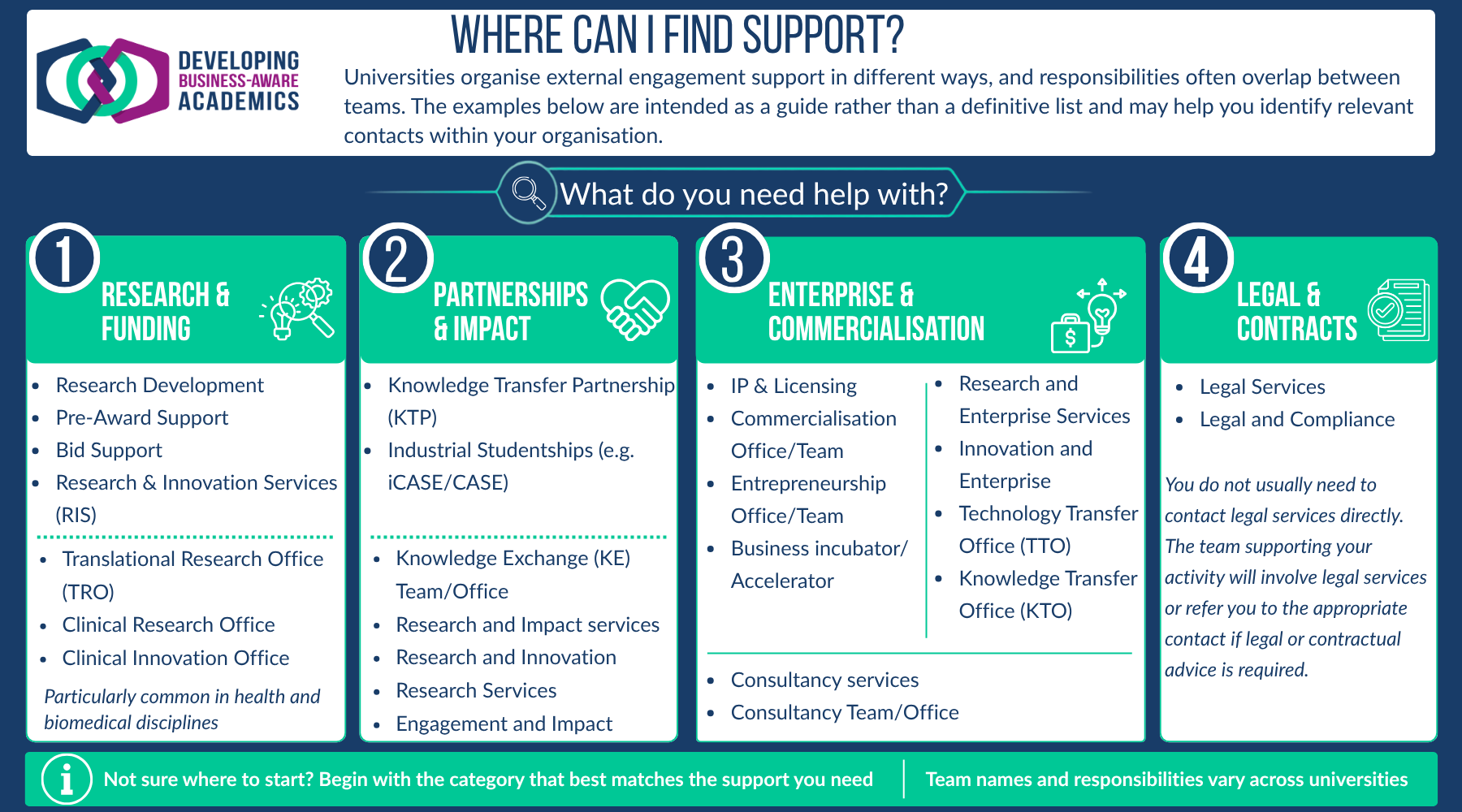
Disclose to your Tech Transfer Office (TTO) or equivalent team within your university; they assess patentability/market, file IP where appropriate, and explore licensing or spin-out routes with you. If you are unsure who to contact, see the Where can I find support? section below, where we have compiled a list of common team names to help you identify the most appropriate source of advice and support within your organisation.
Licensing & collaboration: For university–business deals, many TTOs start from model agreements to speed up negotiations around IP ownership, licensing and publication.
Spin–outs: Deal terms are increasingly benchmarked against TenU’s University Spinout Investment Terms (USIT) Guide (and USIT for Software) to create a transparent “landing zone” for equity, royalties and founder/investor alignment.
For further insight into commercialisation, we recommend you check the Times Higher Education (THE) collection of articles covering different aspects of research commercialisation as they offer insights into different stages of commercialisation, from laying the groundwork to protecting your intellectual property and securing funding.
The case study below shows how Rachel Malthouse combined research, professional practice, and lived experience to develop a digital tool that supports autistic children in their everyday lives.

Empowering autistic children through digital play
Read how Rachel Malthouse created the Jam Up app and worked with external partners to support autistic children with day-to-day activities.
Read more about Rachael's case study5. Informal Mechanisms
There are also more informal ways of initiating connections with external organisations that can both inform your research and potentially lead to longer-term collaborations.
Initial conversations
What it is: Short, exploratory conversations to understand an organisation’s interests, needs and assess whether your expertise could help. No commitment, just discovery.
You might find yourself having these conversations at conferences or industry events, through introductions from colleagues, or even by reaching out to someone directly. Sometimes these early chats lead to more formal collaborations; other times, they simply give you useful insights that can make your research more relevant or impactful.
If you would like support preparing for informal conversations with external organisations, DBAA’s free coaching sessions can help you clarify your aims, consider your approach, and identify practical next steps.

Free coaching for PGRs and ECRs
Discuss your goals, prepare for potential conversations, and identify practical next steps.
Things to keep in mind: Be mindful of protecting your intellectual property, but also remember that you’re representing your university in a broad sense. It can help to have an idea of what your institution can offer, such as access to facilities, equipment, or support with training. You might play a direct role in a collaboration, or just help connect the right people. Often, it’s less about a specific outcome and more about building positive, mutually beneficial relationships.
You don’t need to know everything your university does, but having a general sense beyond your own research area can be useful. Universities are always exploring new ways of working with external partners, and being able to show you’re part of that can be a real plus as your career develops.
The report below, for example, can serve as a useful starting point for understanding how businesses view engagement with universities, while also providing insights into how universities can better support researchers to engage beyond academia.
6. Public and Policy Engagement
Some of the formal ways of working with external partners outlined above also apply when engaging with the public(s) and policymakers, as this can often involve collaborating with a diverse range of organisations. While working with large companies can be quite different from engaging with to the public or policymakers, there are some common themes.
One of the most important is mutual value—thinking about how both sides can benefit. You’ll likely find it useful to get comfortable explaining your research clearly and concisely to people outside your field. Building networks and relationships can also make a big difference, providing a strong foundation for many kinds of engagement beyond academia.
Think of public engagement as a conversation, not a broadcast. It’s about sharing your research in ways that invite questions and ideas from people who might be affected by, use or question your work, and then using what you hear to shape what you do next.
As the National Coordinating Centre for Public Engagement (NCCPE) puts it:
“Public engagement describes the many ways in which the activity and benefits of higher education and research can be shared with the public. Engagement is, by definition, a two-way process, involving interaction and listening, with the goal of generating mutual benefit.”
If you’d like to explore this further, the NCCPE offers a helpful quick guide to high-quality public engagement.
Watch the short video below to explore how engagement with publics can contribute to better research and wider impact.
Policy engagement, like public engagement, can take many forms. It can range from an informal conversation, to something more structured, such as responding to consultations, giving evidence to parliament, or taking part in longer-term collaborations or fellowships. At its core, it’s about using insights from your research to contribute to policies that serve the public interest.
Policymakers are often looking for relevant evidence, expertise, and experience, but they may not have time to read academic papers. Short, clear summaries and targeted recommendations can therefore be especially valuable ways of communicating your findings.
As Holmes-Henderson and Lewin (2025: 4) describe it:
‘Policy engagement is an umbrella term describing the various ways in which research and policy professionals connect and collaborate in the public interest. From informal conversations to formal enquiries, in consultation or sustained collaboration, policy engagement enables researchers and policymakers to improve public policy through making the most of the best available evidence, expertise and experience.’
Suzy Rockey, writing for UPEN, has put together a quick guide on getting started with policy engagement during your PhD, which you might find helpful.
7.Further information, support and opportunities
While we’ve highlighted a range of organisations and initiatives here, this isn’t an exhaustive list. It’s also worth exploring what support is available within your own university, as this is often the best place to find tailored advice, relevant training, and local opportunities.
Within your department, you might start by speaking with your supervisor or someone in a role such as Director of Research and Impact (or similar). They may not be able to support you directly, but they can usually point you towards the right people—such as public or policy engagement teams, researcher development teams, or knowledge exchange (KE) and impact networks.
Business and Innovation
- Explore UKRI’s overview of the research commercialisation process and discover relevant opportunities and support programmes
- Sign up for Konfer, a digital brokerage tool by the National Centre for Universities and Business Collaboration(NCUB)National Centre for Universities and Business Collaboration (NCUB) where you can look for opportunities to collaborate and funding calls.
- Learn about Knowledge Transfer Partnerships (KTPs) through Innovate UK, and explore opportunities to apply for associate roles in active projects.
- Take part in the Your Entrepreneurs Scheme (YES), an international competition that helps you explore how ideas can be commercialised
- Engage with Innovate UK NO Limits community to access Insights, training, funding, support and other opportunities to help you on your innovation journey.
- Build your Knowledge of intellectual property by using the Intellectual Property Office (IPO) IP for Research Fundamentals Toolkit.
- Access training and resources from Aspect (A Shape Platform for Entrepreneurship, Commercialisation and Transformation) for researchers in SHAPE disciplines.
- Develop your idea further with the Innovate UK ICURe programme, which offers tailored training and support for different stages of commercial readiness.
- Look into sector-specific organisations such as Cancer Research Horizons for additional training and support to help you to develop an entrepreneurial mindset and ideas.
Public Engagement
- Explore the resources of the National Centre for Coordinating Public Engagement (NCCPE), a leading organisation with a wealth of resources to support effective public engagement practice and policy.
- Use the Civic University Network Place Navigator to map your local civic landscape, understand key players (e.g., councils, the NHS, care providers, and businesses), sectors and systems. It can help you understand a sector and its priorities, identify potential contacts, and clarify your organisation’s role, so you can plan effective collaboration.
- Access discipline-specific resources and guidance. For example, the Public Engagement with Data Research Initiative (PEDRI) offers tools and information to support meaningful public involvement and engagement with data and statistics.
- Develop your skills through the University of London’s School of Advanced Studies’ RESHAPED training platform, which includes a dedicated Public Engagement Hub for humanities researchers.
- Learn from examples and training materials available through the Voice of Young Science resource library, which supports public and policy engagement and communicating research.
- Build your confidence in public dialogue through the Open University’s free course, ‘Achieving Public Dialogue’.
- Connect with practitioners in Wales through Rhwydwaith Cyd-gynhyrchu Cymru (Co-Production Network for Wales), a network supporting co-production and involvement in public services.
- Connect with practitioners in Scotland through the Scottish Public Engagement Network (ScotPEN), which welcomes anyone interested in public engagement.
Policy Engagement
- Explore opportunities through the UK National Academies, such as the British Academy, Royal Society, Royal Academy of Engineering, the Academy of Medical Sciences and the Academy of Social Sciences and sign up for their newsletters to stay informed. As an example, the Royal Society runs a Pairing Scheme, offering postdoctoral researchers a chance to link up with Westminster policymakers.
- Check the Parliamentary Office of Science and Technology (POST) for fellowships, opportunities to engage with policymakers and subscribe to their updates.
- Learn from the Knowledge Exchange Unit by accessing practical guidance on engaging with Parliament, and subscribe to their weekly newsletter for calls for evidence and fellowship opportunities.
- Connect with UPEN (Universities Policy Engagement Network) to find opportunities with national and local government, and join their events and mailing lists.
- Work through the Future Leader Fellows Development Network Policy Toolkit,which offers a structured exploration of the policy landscape in the UK, global policy engagement and communication tips.
- Strengthen your policy engagement knowledge using CLOSER’s Policy Hub and wider collection of resources on working with policymakers, particularly if your research involves longitudinal data.
- Build your understanding of policy engagement through UCL’s free online course: Public Policy Engagement Online Series which provides a structured introduction to working with policymakers and influencing policy.
Navigating Support in Your University
Knowing where to ask for support can make it easier to begin engaging beyond academia. Although many opportunities to connect with non-academic organisations begin informally, it is important to consider issues such as confidentiality, commercial interests, and how research evidence is communicated and used, as well as the policies and processes that can help protect everyone involved. The infographic below provides an overview of the university teams that may be able to support you, although their names and responsibilities will vary between organisations.