Fay Kahane: Supporting sustainable beekeeping through social and ecological research
Fay Kahane has an academic background in biology, anthropology, and human geography, alongside 20 years professional experience in UK ecology which included advising the Welsh Government on Protected Species. Now based at the University of Exeter, she works with practitioners to address sustainability problems. Her PhD research with UK beekeepers bridges ecology and social science to better understand sustainable beekeeping practices.
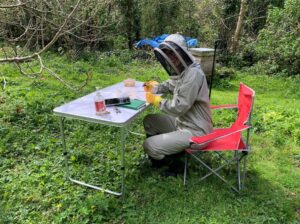
Fay’s interdisciplinary research combines ecological monitoring with insights from the beekeeping community. Working closely with both commercial and hobbyist beekeepers across Cornwall, Fay tracks colony health, hive weight and management practices while also analysing guidance produced by beekeeping organisations, government agencies, academics and industry bodies. By layering this evidence with local knowledge from beekeepers themselves, her research builds a rich, detailed understanding of beekeeping practices and identifies practical pathways towards sustainability – balancing healthy colonies, productive honey yields, and environmental stewardship.
Buzzing for change
The impact of her work is already being felt beyond the research community. Fay has helped local councils evaluate the design and management of urban parks across Cornwall, for green spaces that benefit both wildlife and local communities. Urban green spaces can provide vital habitat for pollinators while also improving the health and well-being of residents. By developing a practical ‘blueprint’ for councils, Fay’s work helps to ensure that pollinator conservation is considered in urban planning.
Despite returning to academia, Fay still considers herself a practitioner. Years of hands-on experience continue to shape the questions she asks and the way she approaches research. Building relationships with beekeepers has created the trust needed for meaningful collaboration. While the findings of her PhD will contribute to future policy, the most immediate impact will be for beekeepers themselves. Her work demonstrates the real-world benefits that strong research-industry collaborations can bring, providing keepers with the evidence they need to make informed decisions about their practice. Furthermore, this link ensures questions and concerns direct from practitioners influence academics – providing the necessary real-world experience to make informed decisions about their research.

Fay's top tips
- Be aware of opportunities anywhere – chat to people in your community to identify potential collaborators!
- Make sure you can explain your research clearly.
- Be respectful of all types of knowledge – we all bring something different to the table!
Fast facts:
What sparked your initial non-academic connections?
- My PhD research partnership includes influential members of the Bee Farmers’ Association (BFA), British Beekeepers Association (BBKA), and Bee Improvement & Bee Breeders Association (BIBBA), along with contacts at the Natural Beekeeping Trust.
Did you have support from the university?
- Absolutely. One of my supervisors is based in the Business School. Knowing people from the Business School helped open doors to industry collaboration, and so did my local network. My supervisors have been great at connecting me to a wider network of researchers.
How did you formalise the relationship?
- I created a ‘beekeeper-research partnership’ at the very outset of my PhD; building from my supervisors’ networks. Through a rigorous ethics process, this partnership was formalised and documented in compliance with requirements from my funders and the University.
How were your collaborations funded?
- My PhD is ESRC-funded; I wrote a proposal that included industry engagement as a stipulation. I applied for and received a top-up of this fund to complete workshops and apiary visits, and have also received funding from the Patient and Public Involvement and Engagement (PPIE) Participant Payment Fund; the Humanities, Arts and Social Sciences (HASS) faculty at the University; and the HaSS Cornwall Environmental Justice Research Cluster; along with approved top-ups from unspent portions of my supervisors’ allocated funds.