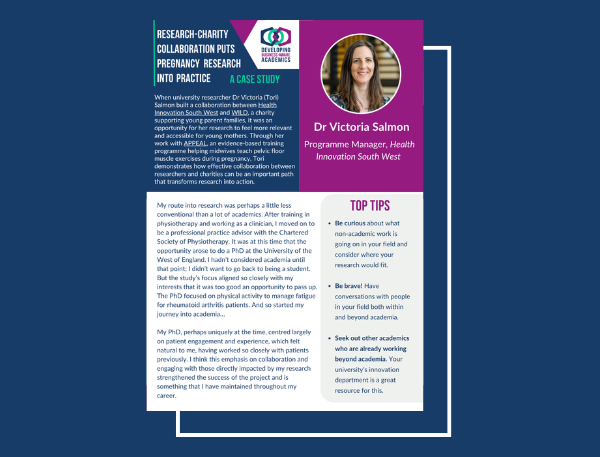
Dr Victoria Salmon: research-charity collaboration puts pregnancy research into practice
 When university researcher Dr Victoria (Tori) Salmon built a collaboration between Health Innovation South West and WILD, a charity supporting young parent families, it was an opportunity for her research to feel more relevant and accessible for young mothers. Through her work with APPEAL, an evidence-based training programme helping midwives teach pelvic floor muscle exercises during pregnancy, Tori demonstrates how effective collaboration between researchers and charities can be an important path that transforms research into action.
My route into research was perhaps a little less conventional than a lot of academics. After training in physiotherapy and working as a clinician, I moved on to be a professional practice advisor with the Chartered Society of Physiotherapy. It was at this time that the opportunity arose to do a PhD at the University of the West of England. I hadn’t considered academia until that point; I didn’t want to go back to being a student. But the study’s focus aligned so closely with my interests that it was too good an opportunity to pass up. The PhD focused on physical activity to manage fatigue for rheumatoid arthritis patients. And so started my journey into academia…
My PhD, perhaps uniquely at the time, centred largely on patient engagement and experience, which felt natural to me, having worked so closely with patients previously. I think this emphasis on collaboration and engaging with those directly impacted by my research strengthened the success of the project and is something that I have maintained throughout my career.
Tori's top tips
- Be curious about what non-academic work is going on in your field and consider where your research would fit.
- Be brave! Have conversations with people in your field both within and beyond academia.
- Seek out other academics who are already working beyond academia. Your university’s innovation department is a great resource for this.
My postdoctoral work has been mostly on the NIHR-funded APPEAL project that developed training for midwives to teach pelvic floor exercises during pregnancy as part of routine antenatal care. One in three people will experience accidental leaking of urine, known as urinary incontinence, towards the end of a pregnancy and following birth.
Although there were already recommended pelvic floor muscle exercises with the potential to prevent one in four cases, our ethnographic research and literature reviews highlighted that these were not routinely taught or even spoken about due to the embarrassing nature of the problem and a lack of confidence among midwives.
The aim of our research has always been to help pregnant people understand the risk of incontinence during and after pregnancy, show how simple pelvic floor muscle exercises can prevent or manage symptoms, and give midwives the confidence to share this important guidance.
Having identified that most people will see a midwife regularly throughout their pregnancy, we developed a training programme to help midwives provide pelvic floor muscle exercise advice and support.

“When I have a midwife tell me how much they’ve benefited from APPEAL training, I know I’m in the right place and that it’s all worth it.”
I’m really proud of how far the project has come. Through our pilot trial, we saw that this training has potential to have a substantial positive impact on reducing urinary incontinence and could help people around the UK and beyond.
A key collaboration of ours, and a great demonstration of our work making a real difference to pelvic floor health for pregnant people and parents, was between the APPEAL project, Health Innovation South West and the WILD Young Parents Project, a charity based in Cornwall that works with parents under the age of 24.

“Our successful collaborations with WILD and Health Innovation South West are helping us genuinely improve pelvic floor health for pregnant people.”
Final reflections:
Our collaboration with WILD was an amazing opportunity to reach a younger demographic, co-producing video resources alongside them that felt relevant to their experiences. We wanted our research to produce resources that were accessible to everyone. Teenage parents are one group that are not often given the opportunity to have their voices heard, and this partnership helped achieve this. The approach has been really well received, and Cornwall has since become one of the areas in which APPEAL training has been adopted. WILD has been one of our champions, sharing the videos with families and highlighting the importance of pelvic floor health.
It hasn’t always been easy, but I believe in using research to move things forward, and when I have a midwife tell me how much they’ve benefited from APPEAL training, I know I’m in the right place and that it’s all worth it.