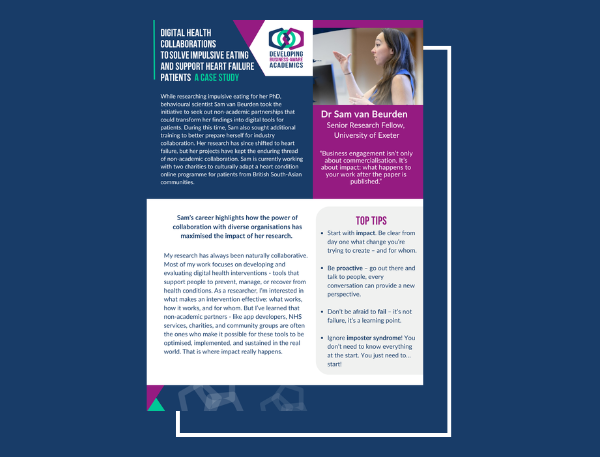
Dr Sam van Beurden: Digital health collaborations to solve impulsive eating and support heart failure patients
While researching impulsive eating for her PhD, behavioural scientist Sam van Beurden took the initiative to seek out non-academic partnerships that could transform her findings into digital tools for patients. During this time, Sam also sought additional training to better prepare herself for industry collaboration. Her research has since shifted to heart failure, but her projects have kept the enduring thread of non-academic collaboration. Sam is currently working with two charities to culturally adapt a heart condition online programme for patients from British South-Asian communities.
Sam’s career highlights how the power of collaboration with diverse organisations has maximised the impact of her research.
My research has always been naturally collaborative. Most of my work focuses on developing and evaluating digital health interventions – tools that support people to prevent, manage, or recover from health conditions. As a researcher, I’m interested in what makes an intervention effective: what works, how it works, and for whom. But I’ve learned that non-academic partners – like app developers, NHS services, charities, and community groups are often the ones who make it possible for these tools to be optimised, implemented, and sustained in the real world. That is where impact really happens.
Sam's Top Tips
- Start with impact. Be clear from day one what change you’re trying to create – and for whom.
- Be proactive – go out there and talk to people, every conversation can provide a new perspective.
- Don’t be afraid to fail – it’s not failure, it’s a learning point.
- Ignore imposter syndrome! You don’t need to know everything at the start. You just need to… start!
My background
I’ve a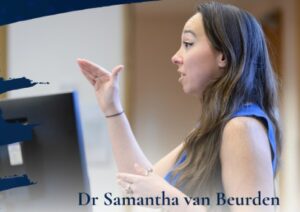 lways had a real love of learning, so a research career has been a natural fit. I’m also fascinated by people – how we think, behave, and change – which is what led me to study Psychology as an undergraduate. I went on to complete a master’s in Psychological Research Methods, but still wasn’t fully sure what I wanted to specialise in. After spending a couple of years in Australia and the Netherlands, I came back to the UK and completed a second master’s in Social and Organisational Psychology.
My PhD focused on impulsive eating and the way our behaviour is shaped by things like food marketing, the environments we are in, our social contexts, cultures, and personal habits. I ended up identifying techniques that help people to cope with these triggers better to support changes in eating behaviour. From the very start, it was multidisciplinary and applied. I worked closely with people trying to lose weight, and with a company to help develop an app that made those behaviour change techniques accessible in everyday life.
Looking back, I think academia felt like a place where I could build confidence through learning and structure. I had to work through that familiar worry of “Am I good enough?”, and that second master’s became my way back into academia and research. It was also where I met Colin Greaves, who later became my PhD supervisor.

Developing industry partnerships to turn research into practice
Since completing my PhD, my research focus has shifted from eating behaviour to heart failure – but one thing has stayed consistent: every project I work on has at least one non-academic partner. For me, that’s not an optional extra. It’s part of how I try to ensure that the research is more likely to be meaningful and has a possible translational pathway. I’ve seen brilliant projects produce excellent tools that then simply sit on a shelf, because there is no infrastructure or investment to maintain them once the funding ends.
Working with industry isn’t always straightforward. Timelines and priorities can look very different in academia compared to the commercial world. But when expectations are clear, and goals are aligned, these partnerships can be the difference between a promising innovation and something that actually lasts.
I also think it’s important for early-career researchers to realise that business engagement isn’t only about commercialisation. It’s about impact: what happens to your work after the paper is published.
There are lots of ways to build these collaborations. For example, Knowledge Transfer Partnerships can be a strong route into longer-term collaborative partnerships. There are also platforms that enable partnering. For example, the NIHR has its Expertise Partnering Service, where companies define a problem and the expertise they need, and academics can respond.
For me personally, networking and being proactive have always mattered. During my PhD, I completed a SetSquared training programme that helped me learn how to talk about my research in a way that made sense to an industry-focused audience. Opportunities like that can be genuinely confidence-building, and they may open doors you weren’t even aware of.
I’d love to see more structured mentorship or shadowing schemes for early-career researchers who want to build partnerships outside academia. It can feel intimidating at first, but it really doesn’t have to be – and the earlier people get exposed to this side of research, the more effective and impactful their work can become.
One of the key programmes I’ve worked on in recent years is REACH-HF, a home-based cardiac rehabilitation programme designed to support people living with heart failure. The digital platform, like the original paper-based version, includes support with things like stress and anxiety management, symptom monitoring, and guided exercise programmes. It is designed so that healthcare professionals (and where appropriate, friends or family) can be involved too, making it easier to support progress and enable more efficient personalised remote consultations.
D:REACH-HF was included in a recent NICE Early Value Assessment of digital cardiac rehabilitation programmes and is one of seven technologies that are now recommended for use in the NHS for further evidence generation for digital rehabilitation services, for the next few years. The recent report from the National Audit of Cardiac Rehabilitation suggests that D:REACH-HF is currently in use by 18 NHS cardiac rehabilitation services to support their patients living with heart failure, with further sites planning adoption in the near future.
Fast facts:
What sparked your initial connections?
- Necessity. I needed expertise beyond my own capacity, so I went out looking for companies capable of developing my ideas.
Did you have support from the university?
- My supervisors gave me the space to find my own training and partnerships.
How did you formalise the relationships?
- Collaboration agreements, Memorandums of Understanding, and supplier contracts.
- How were your collaborations funded?
- My projects have received funding from the NHS, NIHR, British Heart Foundation, and commercial partners. Outside of research, my work has received funding from the University of Exeter Impact Funding and Knowledge Transfer Partnerships. My current project is funded by LEAP through the EPSRC.
“Every project I work on has at least one non-academic partner. For me, that’s not an optional extra. It’s part of how I try to ensure that the research is more likely to be meaningful”
After REACH-HF was shown to be effective, I joined the project to support the next stage: preparing it for wider delivery and working on how it could be adapted for NHS delivery. I later helped secure funding to support the development of a digital version of the programme: D:REACH, an online platform designed to help patients understand their condition and build confidence in managing it day to day.
More recently, I’ve been working on a LEAP-funded project to culturally adapt D:REACH-HF for British South Asian communities. This work is being shaped in close partnership with community organisations, including South Asian Health Action (SAHA) and Dhek Bhal, who are already doing vital work to engage, educate and empower communities around health.

Final reflections
Overall, I’ve come to believe that research only creates maximum impact when it’s built with strong collaborations with non-academic partners. A big part of my journey so far has been driven by being proactive – but also by having supervisors and teams who encouraged me to explore these partnerships and think beyond traditional academic routes.
At the heart of it, I always try to come back to the same questions: why are we doing this research, who is it for, and what needs to happen for it to genuinely make a difference? Working alongside people and organisations who are closer to the realities on the ground is often what makes that long-term impact possible.