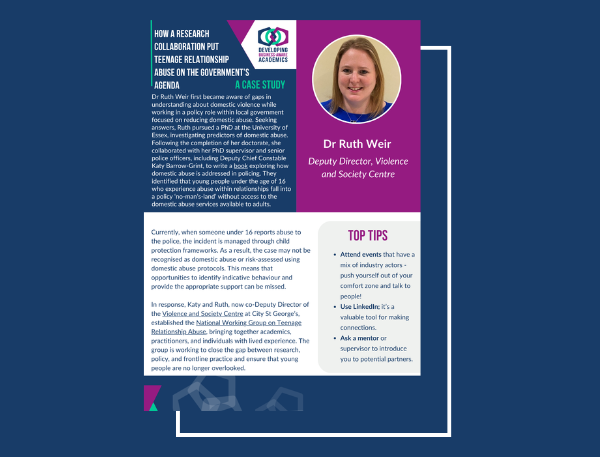
Dr Ruth Weir: how a research collaboration put teenage relationship abuse on the government’s agenda
 Dr Ruth Weir first became aware of gaps in understanding about domestic violence while working in a policy role within local government focused on reducing domestic abuse. Seeking answers, Ruth pursued a PhD at the University of Essex, investigating predictors of domestic abuse. Following the completion of her doctorate, she collaborated with her PhD supervisor and senior police officers, including Deputy Chief Constable Katy Barrow-Grint, to write a book exploring how domestic abuse is addressed in policing. They identified that young people under the age of 16 who experience abuse within relationships fall into a policy ‘no-man’s-land’ without access to the domestic abuse services available to adults.
Currently, when someone under 16 reports abuse to the police, the incident is managed through child protection frameworks. As a result, the case may not be recognised as domestic abuse or risk-assessed using domestic abuse protocols. This means that opportunities to identify indicative behaviour and provide the appropriate support can be missed.
In response, Katy and Ruth, now co-Deputy Director of the Violence and Society Centre at City St George’s, established the National Working Group on Teenage Relationship Abuse, bringing together academics, practitioners, and individuals with lived experience. The group is working to close the gap between research, policy, and frontline practice and ensure that young people are no longer overlooked.
Ruth's top tips
- Attend events that have a mix of industry actors – push yourself out of your comfort zone and talk to people!
- Use LinkedIn; it’s a valuable tool for making connections.
- Ask a mentor or supervisor to introduce you to potential partners.
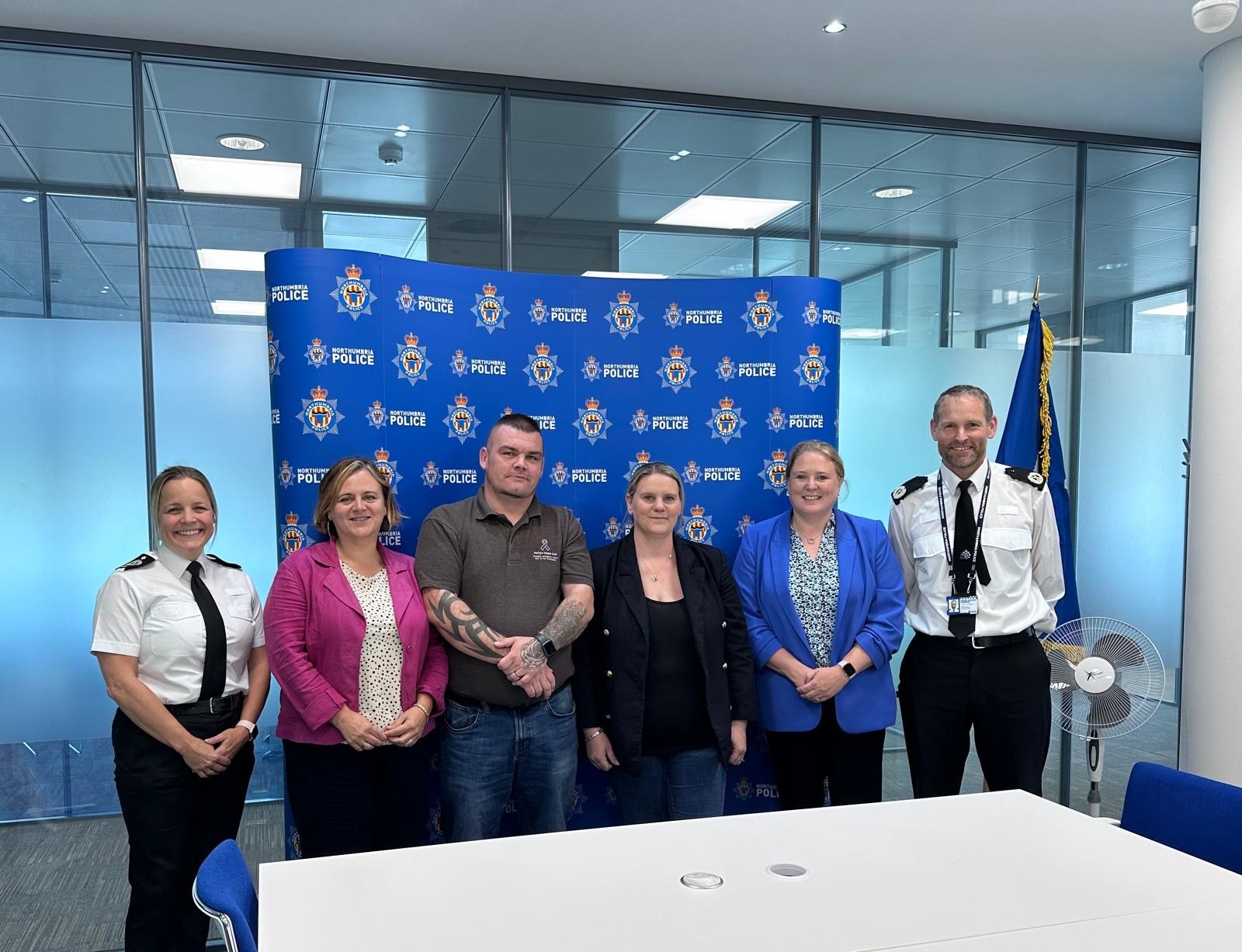
A key feature of the group’s work is its close collaboration with police forces. By conducting research alongside policing partners, the group can examine how cases are currently handled in practice and identify where improvement could be made. The group also hosts workshops with individuals who have lived experience of teenage relationship abuse, ensuring their perspectives shape the development of practical recommendations for change.
The issue has increasingly gained national attention, with teenage relationship abuse now recognised as a priority by the government. Members of the working group have contributed to this growing momentum by meeting with Home Office officials and participating in ministerial roundtable discussions, demonstrating how research partnerships with practitioners can influence policy and practice.
For Ruth, the motivation behind this work is clear: conducting research that leads to meaningful societal impact. She emphasises the importance of collaboration between academia and industry. Partnering with senior police officers has not only provided valuable insight into the complexities of policing domestic abuse but has also enabled access to the wider policing network. With 43 police forces operating across the UK, each with slight procedural differences, these relationships are essential for ensuring research reflects the realities of practice.
“As a researcher, I see my role as facilitating the conversation around policy; I’m helping to inform decision-making.”
At the same time, Ruth’s position as an academic allows her to maintain independence from policing institutions, enabling critical analysis and facilitating dialogue across different perspectives. It is this combination of academic insight and practitioner experience that allows the research to move beyond theory and contribute to practical change that could better protect young people from harm.
Reflecting on the process, Ruth highlights the importance of keeping an open mind and bringing people together around shared goals. Creating opportunities for face-to-face dialogue and collaboration, she believes, is key to developing solutions for complex social challenges.

“From my independent position as an academic, I challenge thinking and connect perspectives that wouldn’t usually meet, fostering fusion between theory and practical change.”
Fast Facts
What sparked your initial connections?
- Perhaps unconventionally, Twitter! My collaborator Katy Barrow-Grint was looking for someone to write a book about policing domestic abuse with her and put a call out on Twitter. It happened serendipitously!
Did you have support from the university?
- Yes, I found that colleagues with external engagement experience were very helpful at putting me in contact with relevant partners.
How did you formalise your research relationships?
- My PhD was in collaboration with Essex County Council via a joint grant. In a recently funded project, we will have a collaboration agreement between the police force and other universities involved in the research. We have data sharing agreements with the police forces and other agencies. Some members of the working group were invited; others have been to events and have asked to join. We now have a smaller steering group for key decision-making. Two of the stakeholders have become Practitioners in Residence at City St George’s, one is now an honorary research fellow.
How were your collaborations funded?
- My PhD was funded by the ESRC and Essex County Council. I have also received funding from the Home Office, Comic Relief and Colchester Borough Homes.