Dr Anna Price: The AI chatbot that could improve access to health services for young people with ADHD
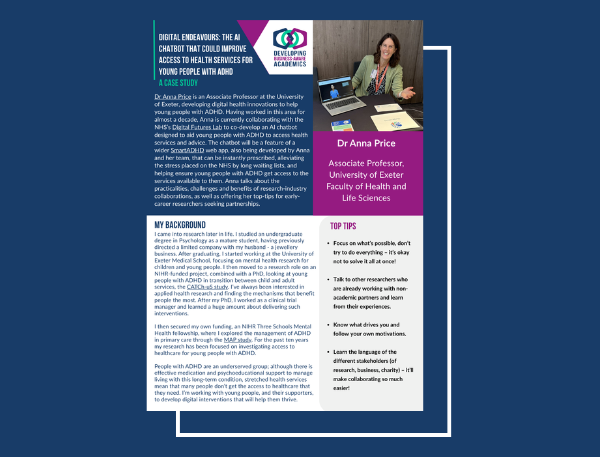
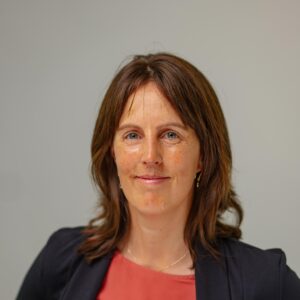
Dr Anna Price is an Associate Professor at the University of Exeter, developing digital health innovations to help young people with ADHD. Having worked in this area for almost a decade, Anna is currently collaborating with the NHS’s Digital Futures Lab to co-develop an AI chatbot designed to aid young people with ADHD to access health services and advice. The chatbot will be a feature of a wider SmartADHD web app, also being developed by Anna and her team, that can be instantly prescribed, alleviating the stress placed on the NHS by long waiting lists, and helping ensure young people with ADHD get access to the services available to them. Anna talks about the practicalities, challenges and benefits of research-industry collaborations, as well as offering her top-tips for early-career researchers seeking partnerships.
Our case study series features inspiring researchers discussing their careers and sharing tips on how they engage beyond academia. If you would like to be featured, send us an email at DBAA@exeter.ac.uk!
Anna's Top Tips
- Focus on what’s possible, don’t try to do everything – it’s okay not to solve it all at once!
- Talk to other researchers who are already working with non-academic partners and learn from their experiences.
- Know what drives you and follow your own motivations.
- Learn the language of the different stakeholders (of research, business, charity) – it’ll make collaborating so much easier!
My background
I came into research later in life. I studied an undergraduate degree in Psychology as a mature student, having previously directed a limited company with my husband – a jewellery business. After graduating, I started working at the University of Exeter Medical School, focusing on mental health research for children and young people. I then moved to a research role on an NIHR-funded project, combined with a PhD, looking at young people with ADHD in transition between child and adult services, the CATCh-uS study. I’ve always been interested in applied health research and finding the mechanisms that benefit people the most. After my PhD, I worked as a clinical trial manager and learned a huge amount about delivering such interventions.
I then secured my own funding, an NIHR Three Schools Mental Health fellowship, where I explored the management of ADHD in primary care through the MAP study. For the past ten years my research has been focused on investigating access to healthcare for young people with ADHD.
People with ADHD are an underserved group; although there is effective medication and psychoeducational support to manage living with this long-term condition, stretched health services mean that many people don’t get the access to healthcare that they need. I’m working with young people, and their supporters, to develop digital interventions that will help them thrive.

“I’m motivated to use my research to impact people’s lives. Working with others who have a shared vision and values helps to make that happen.”
Collaboration with Digital Futures Lab
Our team are developing a chatbot that will provide advice for young people with ADHD, using NHS resources. We aim to provide easier access to health services, particularly for those who struggle to concentrate. We have also explored using AI models to provide information for people for whom English is not their first language, and for people with different levels of comprehension. It’s still an early prototype, but we hope to integrate it into a wider NHS web app so that it can be prescribed.
he chatbot is a UKRI LEAP digital health hub-funded project. I’m collaborating with the Digital Futures Lab, part of the NHS Torbay and South Devon Foundation Trust, a unique and progressive lab that operates within NHS settings. Their team of digital experts focus on immersive technologies and so the collaboration is perfect for developing the chatbot, as we have a strong alignment of interests and don’t need to outsource the programming.
Finding the best model to suit this kind of collaboration can be challenging; we’re in the process of setting up a formal IP sharing agreement. But the strengths we each bring to the project, the practical programming skills and the research, make the final product so much more implementable – all the logistics are worth it!

Fast Facts
What sparked your initial connections?
The research has always been grounded in patients, experts by experience, in order for there to be a translational impact. My PhD saw me work with charities like the ADHD Foundation and UKAAN, and NHS England, so collaboration has been embedded in my work from the very start. Funding has been a driver of collaboration; many grants outline that there must be an industry partner on the project.
Did you have support from the university?
Exeter Innovation has been a great help by assisting me with grant applications, giving advice, and allowing me to undergo the Entrepreneurial Researcher Programme in 2024.
How did you formalise the relationships?
It wasn’t a full agreement at first, but we’re now getting a shared IP agreement set up.
How were your collaborations funded?
My main funder is NIHR, and my current collaboration, the chatbot project, is UKRI LEAP-funded.
Building partnerships
There are many ways to navigate research-industry partnerships. My previous business experience has helped me understand the process of making a project sustainable, but I also recognise that conflicts can arise.
There is a ‘valley of death’ between the development of an intervention and implementation. The last thing we want is for research to sit on a shelf, or only provide solutions that are available in the short term. We want our research to help as many people as possible, and for innovations to be sustained and improved over time. Part of our job as researchers is determining whether that’s best done through a spin-off company, charity, or further collaborations with organisations like the NHS.
Managing IP, aligning timelines and managing expectations are all challenges that arise when setting up partnerships, and I find it helpful to seek advice from connections in my field and learn from their experiences of what has worked in practice and what hasn’t.
Exeter Innovation has also been a great help to me in times of deliberation, and I was able to undertake the Entrepreneurial Researcher Programme in 2024, which helped me to think about the business perspective.
There isn’t one perfect pathway, and at times it can be frustrating, but I’m motivated to use my research to impact people’s lives. Working with others who have a shared vision and values helps to make that happen.