Dr Andrew Cowell: How an industry partnership is providing flatpack wind turbines to rural communities in Kenya
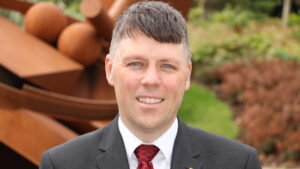
Dr Andrew Cowell, a Senior Lecturer at Glasgow Caledonian University (GCU), is developing flatpack wind turbine systems designed to deliver reliable, portable energy to off-grid communities. Inspired by a school student’s idea, he transformed the concept into a working technology by supervising undergraduate student projects and building collaborations with industry partners in the UK and Kenya.
Portable Power
Andrew’s team has tested and refined the generation system in real-world conditions, helping provide power to critical services such as community hospitals where the electricity supply is unreliable. The approach demonstrates the power of collaboration, applied research, and innovation to deliver broad social impact, from rural electrification to disaster-response applications.
Having worked across both academia and industry, Andrew has allowed inspiration and serendipity to shape the direction of his career and the collaborations it has fostered. His work has largely centred on sustainability, using engineering innovation to identify real-world opportunities for improved efficiency and increased use of renewable solutions that benefit both communities and the environment.
The concept for a portable wind turbine originated from a 15-year-old school student through the Primary Engineer Leaders Award initiative, which invites pupils to propose engineering innovations. Recognising its potential, Andrew supervised a series of undergraduate projects to develop the idea into a working prototype.
A chance introduction from a colleague to E-Safiri Charging Limited, a Kenyan company keen to trial the technology, created the opportunity to take the concept beyond the lab. Alongside UK industry partner, De Courcy Alexander, Andrew secured funding, launching a research-industry collaboration that is now delivering tangible benefits to rural communities in Kenya.
“I’m excited by new knowledge, but we don’t do blue-sky research; we do research that’s directly applicable to industry.”

Andrew's top tips
- Find something that you’re passionate about!
- Go out and speak with people in that area – they will have problems that need to be solved.
- Get a good team around you – you can’t do everything yourself!
“Until our collaboration, the prototype wind turbine was sitting in a lab with great potential but no impact; now it’s bringing power to those most in need at a hospital in Kenya.”
In areas where grid connections are unreliable, the portable wind turbine provides a vital source of electricity, particularly contributing to facilities such as community hospitals. Working closely with a partner on the ground allows Andrew’s team to test designs in real-world conditions and respond quickly to practical challenges, ensuring the device is tailored to local needs and maximises impact.
Andrew sees global potential for the technology, including in disaster response, emergency settings, and refugee camps. Before the collaboration in Kenya, the concept remained a promising laboratory prototype. It is now progressing toward commercial viability while delivering essential power to communities that need it most.
At GCU, a strong focus on applied science has encouraged industry engagement throughout Andrew’s career. For him, building professional relationships has been central to identifying opportunities and turning ideas into reality. Despite challenges around funding and timelines, collaboration has enabled innovation to move from concept to impact. Andrew and his partners continue to refine the flatpack wind turbine, with ambitions to scale its use worldwide.

Fast facts:
What sparked your initial non-academic connections?
- A colleague knew the owner of the Kenyan company and put us in contact.
Did you have support from the university?
- Yes. GCU is very focused on research that’s directly applicable to industry. My PhD supervisor worked in industrial consultancy; industry engagement was always encouraged.
How did you formalise the relationship?
- Once funding was secured, we established a Collaboration Agreement for the project and Non-Disclosure Agreements with our partners.
How were your collaborations funded?
- The Angaza Africa project that started the collaboration was funded by Innovate UK through Energy Catalyst Round 9.